
Automotive Logistics in India: Key Challenges, Digital Solutions, and Future Trends
Key Highlights
- India produced over 28 million vehicles across segments in FY2024, straining an already complex supplier network.
- 45% of automotive manufacturers cite supply chain disruption and parts shortages as their top challenge.
- India's PLI-Auto Scheme encourages the local manufacturing of advanced automotive components to strengthen the domestic automotive supply chain.
- Predictive supply chain planning has helped some automotive manufacturers cut inventory by 15-25%.
Automotive logistics covers everything that moves a vehicle from raw material to dealership floor, including inbound component delivery, plant-side sequencing, outbound distribution, and increasingly, the reverse flow of returns and recalls.
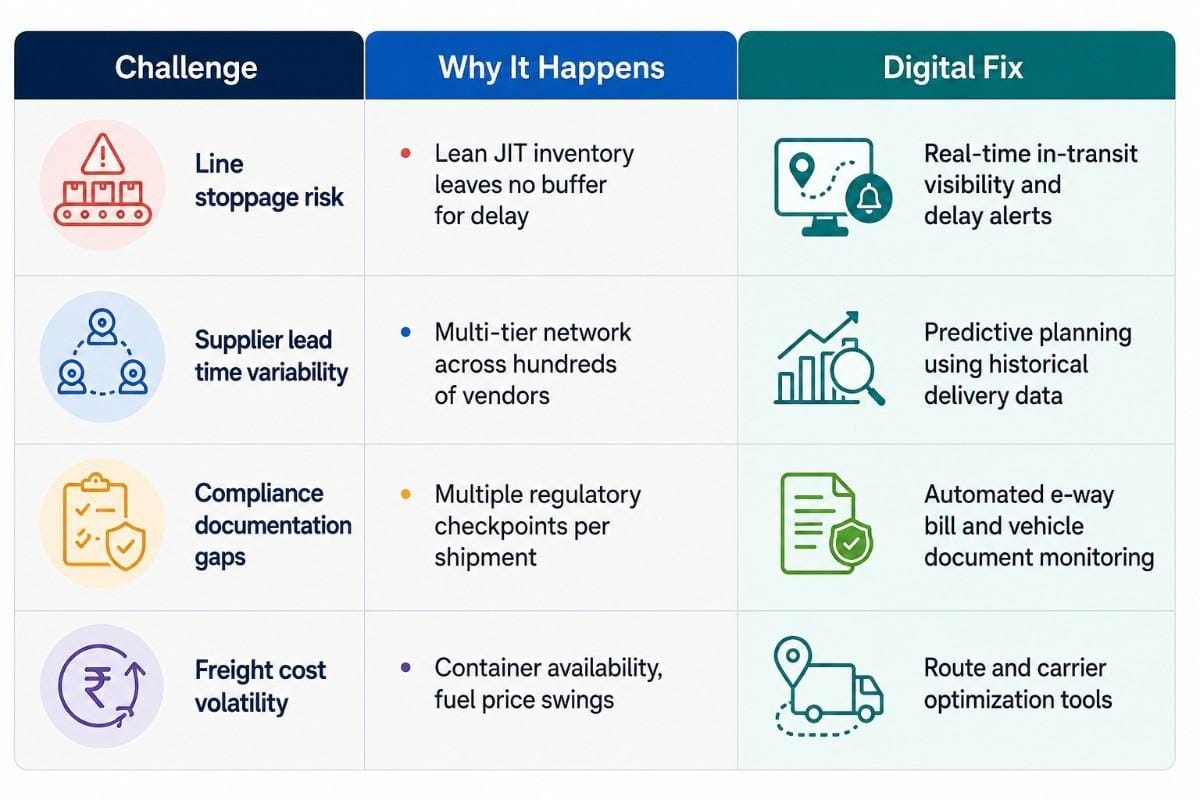
It's a category of logistics with almost no margin for error, because most automotive plants run lean inventory models where a single missed delivery can stop a production line within hours.
India's version of this problem carries its own weight: the country produced over 28 million vehicles across passenger, two-wheeler, and commercial segments in FY2024, and that volume runs through a supplier network spread across hundreds of vendors per manufacturer.
What Does Automotive Logistics Actually Involve?
Automotive logistics is the coordinated movement of components, sub-assemblies, and finished vehicles across a multi-tier supply chain, timed to match production schedules rather than general demand.
A single vehicle typically contains thousands of individual parts sourced from Tier 1, Tier 2, and Tier 3 suppliers, each of whom has to hit a delivery window precise enough to keep an assembly line running.
That precision requirement is what separates automotive logistics from most other manufacturing freight; the cost of a late shipment isn't just a delayed order, it's an idle production line.
Why Do Automotive Supply Chains Break Under Pressure?
Automotive supply chains break most often at the points where lean inventory meets real-world unpredictability. Inconsistent supplier lead times, volatile freight costs, limited container availability, and routing disruptions force plants to revise schedules, expedite shipments, or hold buffer stock they'd rather not carry.
This pressure isn't isolated to India; a global industry survey found that 45% of manufacturers rank supply chain disruption and parts shortages as their single biggest challenge, a figure that's stayed near the top of the list every year since 2022.
This visibility gap is often widest among Tier 2 and Tier 3 vendors; RoaDo’s hardware-free tracking (SIM and browser-based) solves this by enabling real-time visibility without requiring small transporters to install GPS hardware.
How Does the PLI Scheme Change India's Automotive Logistics?
India's Production-Linked Incentive Scheme for the automobile sector is pushing manufacturers toward deeper domestic sourcing, which directly changes the shape of automotive logistics in the country.
Approved by the Union Cabinet in September 2021, the PLI-Auto Scheme aims to strengthen domestic manufacturing and localization of advanced automotive technology products, particularly battery electric and hydrogen fuel cell vehicles.
To qualify for incentives under the PLI-Auto Scheme, companies must meet the prescribed domestic value addition criteria, encouraging greater localization of advanced automotive manufacturing.
For logistics teams, this means more component sourcing shifting inland, which increases the volume of domestic freight movement that needs coordinating rather than reducing it.
Digital Solutions Reshaping Automotive Supply Chain Management
The clearest shift in automotive supply chain management right now is the move from reactive problem-solving to predictive planning built on real-time data. Manufacturers adopting predictive supply chain planning and warehouse automation often see improvements in inventory control, operational efficiency, and warehouse productivity.
Underneath these gains sits a simple requirement: continuous, accurate visibility into where every shipment actually is, not where it was scheduled to be.
For automotive component movement specifically, this is where a Freight Operating System (FOS) like RoaDo becomes relevant on the inbound leg, not for sequencing what happens on the plant floor but for monitoring shipment status, e-way bill validity, and vehicle compliance for the trucks actually carrying those components inland.
AI-based exception alerts enable logistics teams to detect and address transit issues before they escalate, helping maintain delivery schedules and minimizing the risk of production disruptions.
Automotive Logistics Challenges and Digital Fixes
What's Next for Automotive Logistics in India
The next phase of automotive logistics in India will be shaped by electrification and by the same digital visibility trend already reducing inventory and improving planning accuracy.
EVs introduce genuinely new logistics complexity; batteries are heavier, classified as hazardous material requiring special handling, and temperature-sensitive in ways traditional combustion-engine components never were.
At the same time, industry-wide, 64% of manufacturers expect increased adoption of supply chain management software over the coming year, and 79% expect growth in AI-driven applications like demand forecasting and logistics routing.
Platforms like RoaDo are positioned for exactly this shift, giving manufacturers the inbound visibility layer that both PLI-driven domestic sourcing and EV-specific complexity are going to demand more of, not less.
Frequently Asked Questions
1. What is automotive logistics?
Automotive logistics is the coordinated movement of components, sub-assemblies, and finished vehicles across a manufacturer's supply chain, timed to match production schedules.
2. Why is just-in-time manufacturing risky for automotive supply chains?
JIT eliminates buffer inventory to reduce warehousing costs, which means even a small delivery delay can stop a production line.
3. What is the PLI scheme for the automobile sector?
The PLI-Auto Scheme is a ₹25,938 crore government incentive program designed to boost domestic manufacturing of advanced automotive technology products, including electric and hydrogen fuel cell vehicles.
4. How many vehicles does India produce annually?
India produced over 28 million vehicles across passenger, two-wheeler, and commercial segments in FY2024.
5. What are the biggest challenges in automotive supply chain management?
Supply chain disruption and parts shortages rank as the top challenge, cited by 45% of manufacturers in a recent global industry survey.
6. How does real-time visibility help automotive logistics?
Real-time visibility lets logistics teams catch delays early enough to adjust production schedules before a shortage actually stops a line.
7. How are electric vehicles changing automotive logistics?
EV batteries are heavier, classified as hazardous material, and temperature-sensitive, requiring different handling and documentation than traditional components.
8. What is reverse logistics in the automotive industry?
Reverse logistics covers the backward movement of goods through the supply chain, including returns, recalls, warranty replacements, and end-of-life vehicle recycling.
Conclusion
Automotive logistics in India runs on razor-thin inventory margins, which makes even small disruptions in supplier lead time or freight availability far more consequential than in most other manufacturing sectors.
Two forces are reshaping how manufacturers manage that risk: India's push toward domestic component sourcing under the PLI scheme, which shifts more freight movement inland, and the broader industry move toward predictive, data-driven supply chain planning.
Electrification adds another layer of complexity on top of both, introducing battery logistics requirements that traditional combustion-engine component flows never had to account for. As these pressures compound, the manufacturers investing in real-time inbound visibility now will be better positioned to absorb the next disruption rather than react to it after a line has already stopped.
As a comprehensive Freight Operating System, RoaDo supports that visibility layer for the inland component movement feeding India's automotive plants without needing to touch what happens once parts reach the production floor
“Real-time visibility is the key to smoother dock operations. With RoaDo, businesses can track inbound shipments, manage exceptions, and reduce costly detention delays.