
Detention and Demurrage Charges Explained: Causes, Costs, and Prevention Strategies

Key Highlights
- Indian importers pay an estimated ₹3,500 crore annually in demurrage charges alone.
- Indian ports typically offer 3-7 days of free time for imports and 3-5 days for exports before charges begin.
- Daily detention and demurrage rates in India are estimated to range from ₹3,000 to ₹8,000 for standard containers and can double or triple after 7-14 days.
- Demurrage charges in India are governed under Sections 27 and 30 of the Major Port Authorities Act, 2021.
Detention charges and demurrage charges are two of the most misunderstood line items on a freight invoice, often treated as interchangeable when they apply to different stages of a container's journey.
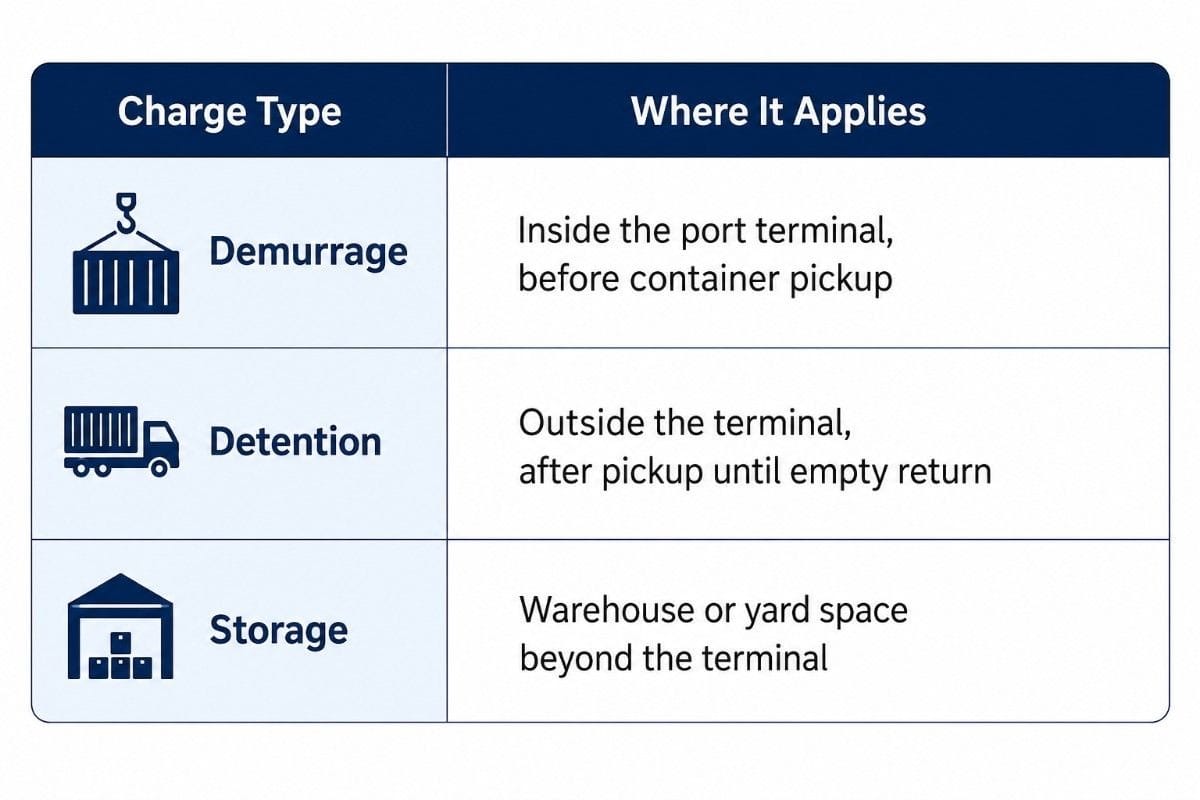
Demurrage is charged when a full container sits inside the port terminal beyond its free time; detention is charged when that same container, once picked up, isn't returned to the carrier on time.
Both exist for the same reason: to keep containers and terminal space moving, but the operational fix for each is different, which is why understanding the distinction matters more than most shippers realize until they're disputing a bill.
What Are Detention Charges and Demurrage Charges in Practice?

Demurrage applies inside the terminal; detention applies outside it once you're holding the carrier's equipment. Demurrage is measured from when a container is unloaded from the vessel until it's picked up and gated out at the port.
Detention is measured from the pickup until the empty container is returned to the carrier's depot. Both charges exist within a free time window granted by the carrier or terminal; once that window closes, per-container, per-day fees begin accumulating.
What Causes Detention and Demurrage Charges in Practice
These charges almost always trace back to a handoff point where execution slipped, customs clearance, trucking availability, warehouse readiness, or empty-container return planning. Common causes of demurrage include customs clearance delays, documentation errors in the bill of lading, and terminal congestion during high-traffic periods, while detention is more often driven by inefficient inland transportation, slow warehouse unloading, or simply not having a truck booked in time to move the container.
RoaDo’s Smart Order & Contract Management prevents this through automated indent allocation and carrier sourcing before the container is even gated out of the port. A cleared container can still generate demurrage if no truck shows up to collect it, which is why the fix often has nothing to do with customs speed at all.
Free time is the number of days a carrier or terminal grants before charges begin; it varies by port, carrier, and container type, and knowing your exact free time and last free date is the single most useful piece of information for avoiding these fees.
How Much Do Detention and Demurrage Charges Actually Cost in India?
Costs in India follow a tiered structure that rewards fast turnaround and increases as delays continue. Indian ports typically grant 3-7 days of free time for import containers and 3-5 days for export containers before applicable charges begin. The exact free-time period and charges vary depending on the port, carrier, container type, and shipping terms.
Charges may increase as delays continue, depending on the carrier, port, container type, and applicable terms. Peak-season conditions and operational disruptions can also contribute to higher charges. At a national scale, the financial impact of demurrage can be significant for Indian importers.
Detention, Demurrage, and Storage Charges at a Glance
Who Is Responsible for Detention Charges and Demurrage Charges
The Incoterms generally determine liability for detention and demurrage charges agreed upon in the shipping contract, not who actually caused the delay. Under Ex-Works terms, the buyer typically bears the demurrage risk once the container is ready at the origin, whereas under Delivered at Place terms, the seller remains responsible until the container reaches its destination terminal.
In India, port demurrage specifically operates under statutory authority, the Major Port Authorities Act, 2021, which empowers designated ports to set demurrage rates and terms under Section 27, with Section 30 granting authority to recover unpaid charges through the sale of goods.
Detention isn't only a port-and-container problem; the same structural issue appears in road freight, where a truck waiting an unreasonable amount of time to load or unload at a warehouse or distribution center creates trucking-side detention, distinct from the container detention discussed above but caused by the same root problem: poor coordination between parties.
This inland version of detention is where a Freight Operating System (FOS) like RoaDo becomes relevant for road freight specifically, not for port-side container demurrage, which sits outside its scope, but for the trucking detention that occurs when a vehicle is held up at a dispatch or delivery point.
Real-time shipment visibility, paired with DPI integrations like VAHAN and GSTN, helps flag e-way bill expiry risks and vehicle compliance issues in real-time, preventing the document-driven delays that lead to inland detention, which is the inland equivalent of the free-time tracking that prevents port detention from accumulating unnoticed.
Prevention Strategies That Actually Reduce Container Fees

The most effective prevention strategies address the specific handoff point causing delay, rather than applying a generic "move faster" approach. Pre-clearing customs before the container arrives, tracking free-day expiry through carrier-provided visibility tools, and scheduling drayage trucking well in advance are the three highest-leverage interventions, since each targets a distinct cause rather than assuming one fix solves everything.
Logistics software specifically reduces exposure through real-time visibility into container milestones, automated alerts before free time expires, and electronic documentation that supports disputing an incorrect charge with time-stamped evidence.
For the inland, trucking-side detention charges that often show up buried in freight invoices, automated invoice audit matters just as much as prevention. RoaDo's automated freight invoice audit and reconciliation capability checks billed detention charges against actual shipment timing data, helping catch disputed or miscalculated line items before payment goes out.
Platforms like this address the inland leg of a problem that, on the port side, requires an entirely different set of carrier and customs relationships to manage.
Frequently Asked Questions
1. What is the difference between detention and demurrage?
Demurrage applies while a container is inside the port terminal beyond free time, while detention applies once the container has left the terminal and isn't returned on schedule.
2. Who is responsible for paying detention and demurrage charges?
Responsibility is typically determined by the Incoterms agreed upon in the shipping contract and can fall on the buyer, seller, or freight forwarder, depending on the terms.
3. How many free days do Indian ports typically offer before charges apply?
Indian ports generally offer 3-7 days of free time for imports and 3-5 days for exports before demurrage charges begin.
4. Can detention and demurrage charges be waived?
Sometimes, carriers may waive charges for documented exceptions like terminal delays or customs holds, but waivers are discretionary and require timely evidence.
5. What is the difference between demurrage and storage charges?
Demurrage is charged by the carrier or port authority for terminal space, while storage charges apply to warehouse or yard space and are usually billed separately.
6. Does detention apply to trucking, not just shipping containers?
Yes, trucking detention occurs when a vehicle waits an unreasonable amount of time to load or unload at a warehouse or distribution center, a separate but related problem to container detention.
7. How can logistics software help reduce detention and demurrage charges?
Logistics software reduces exposure through real-time shipment visibility, automated alerts before free time expires, and electronic documentation that supports disputing incorrect charges.
8. What documents help dispute an incorrect detention or demurrage charge?
Time-stamped records of container movement, gate-in/gate-out timestamps, and correspondence documenting delays outside your control are the strongest basis for a dispute.
Conclusion
Detention and demurrage charges exist as structural incentives to keep containers and terminal space moving, not as arbitrary penalties, but that doesn't make them any less costly when execution slips at a handoff point.
Most of the exposure Indian importers face, an estimated ₹3,500 crore annually in demurrage alone, traces back to preventable gaps in customs preparation, trucking availability, or free-day tracking rather than genuinely unavoidable delays.
The same root problem shows up inland as trucking-side detention, where a vehicle waiting too long to load or unload creates a parallel cost that's easy to overlook until it appears on an invoice.
As carriers and ports continue tightening free-time enforcement, the businesses that treat these charges as a trackable operational metric, supported by real-time visibility and audit-ready documentation, will consistently pay less than those still treating them as an unavoidable cost of doing business. Platforms like RoaDo support that discipline on the inland leg, achieving documented results like a 7-10 days reduction in DSO and catching disputed detention charges before they're paid.
“Managing inland detention starts with better visibility. With RoaDo, businesses can track shipments in real time, audit freight invoices, and identify disputed detention charges before they impact costs.”