
ePOD and Proof of Delivery: What They Are and Why Paper POD Costs You Money
Key Highlights
- ePOD, the full form of which is electronic proof of delivery, is a digital replacement for the signed paper slip confirming a shipment arrived complete and undamaged.
- Tax invoices and e-way bills alone aren't enough to prove goods actually moved for ITC purposes; an Allahabad High Court ruling required delivery acknowledgement and freight payment evidence as well.
- RoaDo customers have seen a 65% faster billing cycle and 7–10 days of DSO reduction tied to faster proof-of-delivery capture and reconciliation.
- A missing or illegible paper POD is one of the most common reasons freight invoices sit unpaid past their due date.
A driver comes back with a stack of paper slips. Two are smudged. One never made it into the folder. Now accounts are chasing a signature from three days ago before an invoice can even go out, and the customer disputing a shortage has nothing but a driver's memory to go on. That's the paper POD problem in one sentence, and it's costing more than most operations teams have actually measured.
ePOD Full Form and What It Actually Confirms
ePOD, the full form, is electronic proof of delivery, a digital record confirming a shipment reached its destination, in the condition and quantity agreed, captured on a driver's device via a hardware-free, browser-based interface instead of a paper form. It typically includes a timestamp, GPS location, a signature or photo, and notes on anything that didn't match the order.
The point of any proof of delivery, paper or electronic, is the same: settling exactly what happened at the point of handover, before that memory fades or a dispute makes it matter. What changes with ePOD is speed and reliability; the record exists the moment delivery happens, not whenever a stack of paper makes it back to an office.
POD Meaning in Transport: The Document Behind Every Delivery

POD, the full form in logistics, is simply proof of delivery. Every commercial shipment, whether tracked on paper or captured digitally, generates one at the moment of handover; it's the document that closes the loop between "shipped" and "confirmed received."
POD meaning in transport goes beyond a formality. It's the record that determines whether an invoice gets paid on time, whether a damage claim holds up, and whether a customer's "we never got this" actually checks out against what a driver documented. Without one, every delivery dispute defaults to whoever argues more persistently.
What Information Should a Standard POD Copy Actually Contain?
A POD copy needs to answer four questions clearly: what was delivered, when, to whom, and in what condition. Beyond that baseline, most PODs capture the receiving party's name, a signature or acknowledgement, and any noted discrepancies, short quantities, visible damage, or wrong items.
The transporter needs it to prove the job was completed and get paid. The consignor needs it to close the order and issue an accurate invoice. The consignee needs it as their own record, especially if a dispute comes up later about what actually arrived.
Why Does Paper POD Actually Cost Your Business Money?
Paper POD doesn't fail dramatically; it fails quietly, one smudged signature and one missing slip at a time, and the cost shows up in places nobody's specifically tracking. A driver's daily stack of paper has to physically get back to an office, get sorted, and get scanned or manually entered before an invoice can even be raised.
This lag between delivery and paperwork reaching accounts is exactly what stretches a billing cycle from days into weeks. Every day a POD sits unprocessed is a day an invoice can't legally go out, which is a day that receivables age further on the books. Multiply that across a full week of deliveries, and the impact on Days Sales Outstanding (DSO) and working capital becomes a significant business risk.
Paper POD vs. ePOD: Where the Difference Shows Up
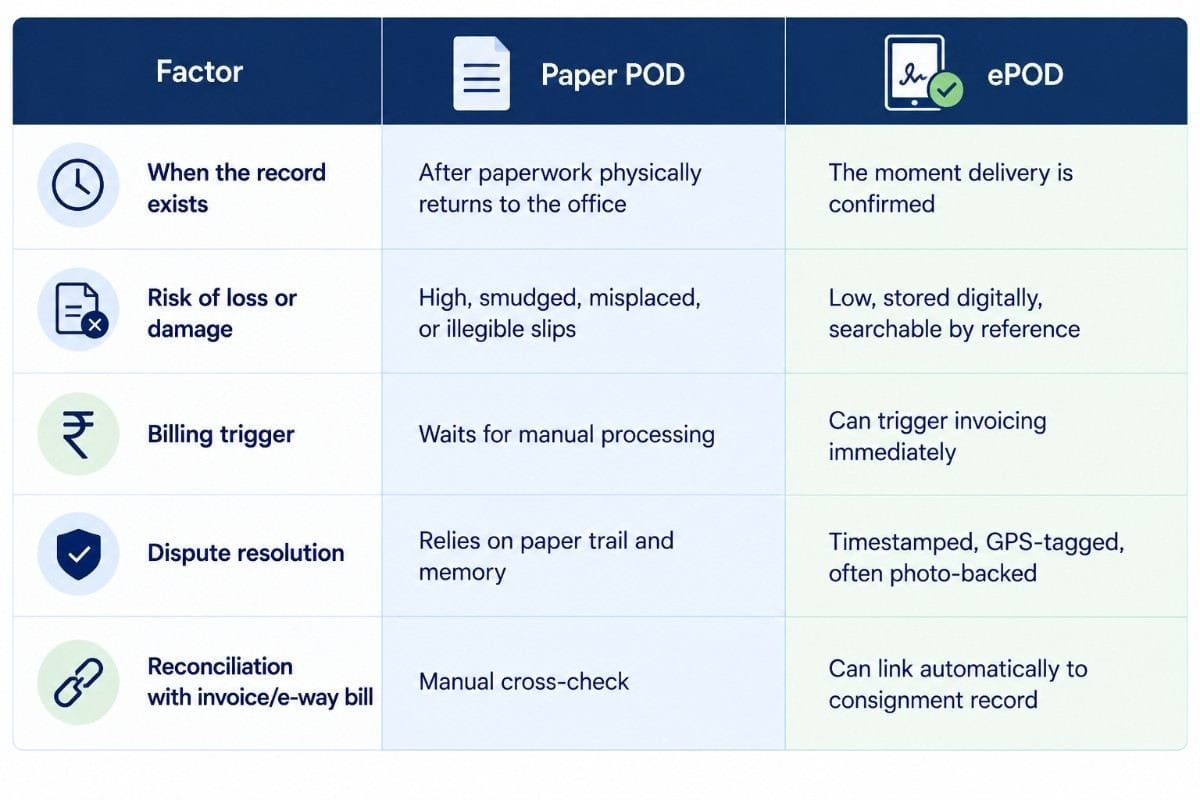
Stacked across hundreds of deliveries a month, they add up to a measurably different billing cycle.
How ePOD Connects to GST Compliance and Input Tax Credit
Proof of delivery isn't just a billing convenience in India; it has real weight in GST disputes. The Allahabad High Court ruled in 2024 that a tax invoice, e-way bill, and goods receipt together are not, by themselves, sufficient to prove the actual physical movement of goods for claiming Input Tax Credit; the claimant also needs evidence like delivery acknowledgement and freight payment records.
That ruling makes a clean paper trail from delivery confirmation back to the invoice worth more than a convenience; it's evidence that can hold up under an ITC challenge. This is exactly the gap platforms like RoaDo close by linking proof of delivery directly to the invoice and e-way bill record for the same shipment, rather than leaving delivery evidence as a separate, easily misplaced document.
By digitizing the handover through RoaDo’s Freight Operating System, customers have seen billing cycles run 65% faster and DSO drop by 7 to 10 days, both tied directly to how quickly delivery confirmation reaches accounts.
Conclusion
Paper POD rarely fails all at once; it fails a slip at a time, and the cost of that failure hides inside billing delays and disputes that are hard to trace back to their real cause. ePOD closes that gap by making the delivery record exist the moment a shipment is confirmed, not whenever paperwork happens to make it back to an office.
In India specifically, that record carries more weight than a billing convenience, given how GST case law now treats delivery evidence as part of proving a genuine transaction. Businesses that link proof of delivery directly to invoicing and compliance data, rather than treating it as a separate filing task, tend to see the difference show up fastest in how quickly cash actually comes in.
As GST scrutiny on transaction evidence keeps tightening, a reliable, searchable proof of delivery record is becoming less of an operational nicety and more of a document worth getting right every time.
Frequently Asked Questions
1. What is the full form of ePOD?
ePOD stands for electronic proof of delivery, a digital confirmation that a shipment arrived as expected.
2. What does POD mean in transport and logistics?
POD stands for proof of delivery, the document confirming a shipment was received, in what condition, and by whom.
3. What information does a POD copy typically include?
Delivery date and time, receiving party details, a signature or acknowledgement, and any noted discrepancies like damage or shortages.
4. Why does paper proof of delivery slow down invoicing?
Paper PODs have to physically return to an office and be manually processed before billing data is available, delaying the invoice cycle.
5. Is proof of delivery legally required for GST compliance in India? Case law indicates that delivery evidence beyond just an invoice and e-way bill can be necessary to support Input Tax Credit claims.
6. How does ePOD reduce delivery disputes?
Timestamped, GPS-tagged records with photos or signatures create clear evidence of what was delivered and when, reducing reliance on memory or paper trails.
7. Can ePOD data be linked to invoicing automatically?
Yes, many electronic proof of delivery systems can trigger or feed directly into the invoicing process once a delivery is confirmed.
8. What's the main difference between POD and ePOD?
POD is the general concept of delivery confirmation; ePOD specifically refers to the digital, device-captured version of that same record.
“Eliminate paper POD delays with faster, digital proof-of-delivery capture.Discover how RoaDo helps connect ePOD, billing, and shipment records seamlessly.”