
FTL vs LTL Shipping: Differences, Costs, and When to Use Each

Key Highlights
- Road transport carries 65% of India’s freight, with FTL representing 84% of that volume.
- FTL reserves the entire truck for one shipper; LTL shares truck space across multiple shippers' consignments.
- In India, LTL typically applies to shipments under roughly 7,000 kg, while FTL applies above roughly 12,000 kg.
- Manufacturing is estimated to reach 30.45% of India's FTL market share by late 2025.
The choice between FTL vs. LTL shipping comes down to one question: how much of a truck does your shipment actually need? Full truckload (FTL) means booking an entire truck for one consignment, whether or not it fills the trailer. Less-than-truckload (LTL) means your goods share truck space with shipments from other businesses, and you pay only for the portion you use. Both move freight by road, but they differ in cost structure, transit time, and how much control you have over your goods once they leave your dock.
The Difference Between FTL and LTL Shipping
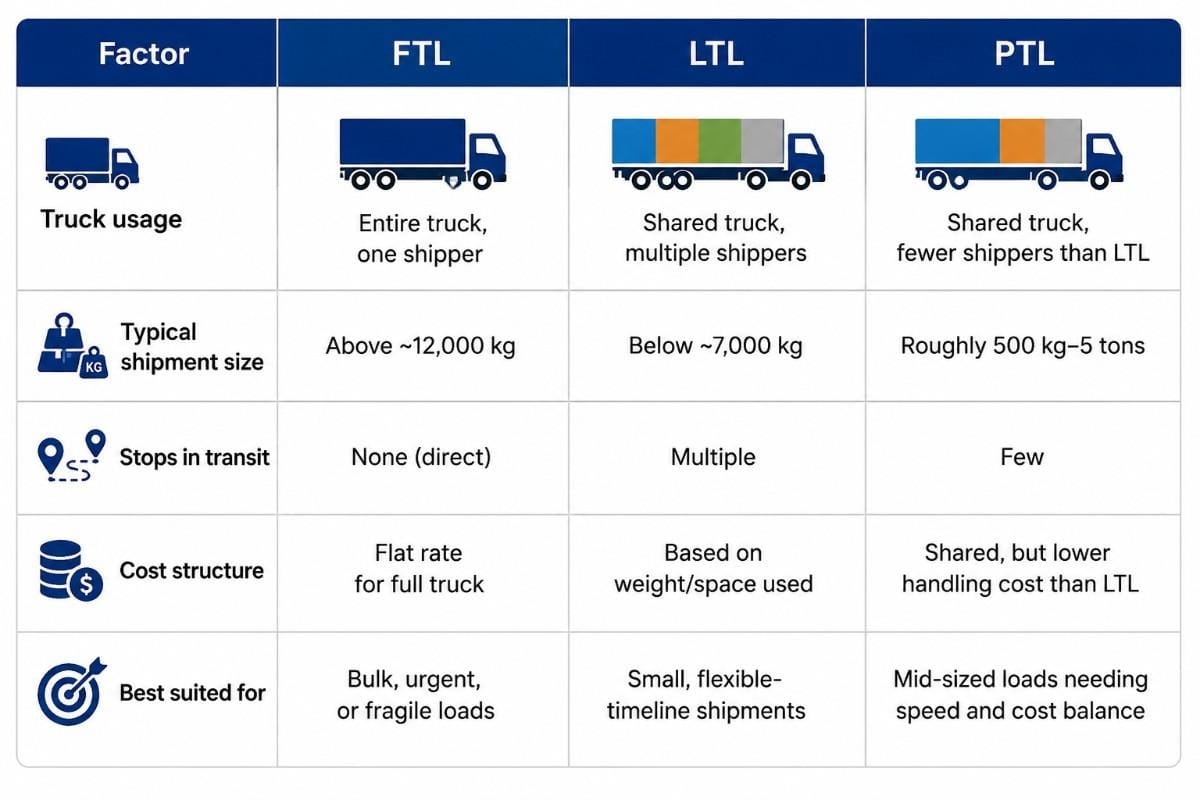
FTL gives you exclusive use of a truck; LTL gives you a shared portion of one. With FTL, your cargo is loaded once, travels directly to its destination, and is unloaded once; there's no intermediate stop for someone else's freight. With LTL, your consignment is combined with cargo from other shippers heading to different destinations, so the truck makes multiple stops along the way.
In India, this distinction is typically drawn by weight: LTL generally covers shipments under about 7,000 kg, while FTL applies to loads exceeding roughly 12,000 kg or occupying a full truck's capacity. Shipments that fall between these two, too big for LTL but not enough to justify a full truck, are where a third, India-specific model called PTL comes in, which we'll cover below.
How FTL and LTL Shipping Costs Are Calculated
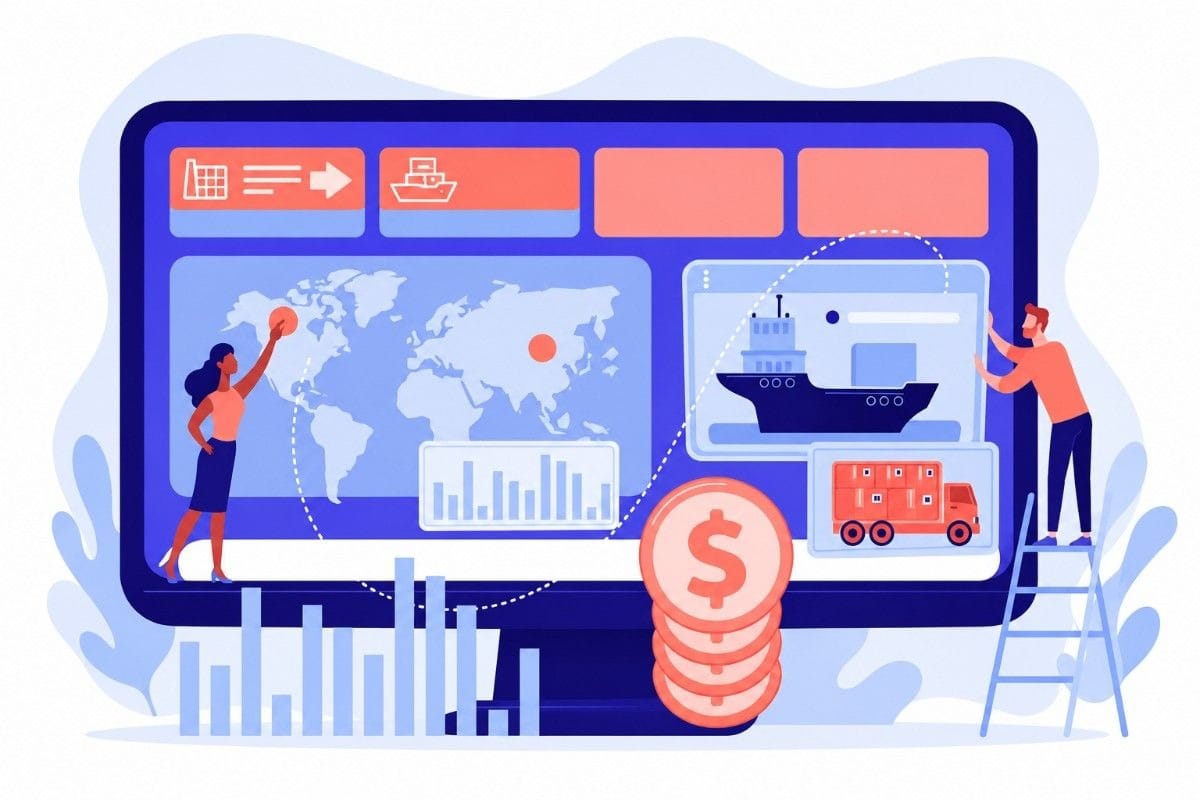
FTL costs are based on a flat rate for the whole truck; LTL costs are based on the space and weight your shipment actually occupies. For FTL, the price is driven mainly by distance. route, and market demand for trucks on that lane; you pay the same whether the trailer is half-full or fully loaded. For LTL, pricing depends on weight, dimensions, and freight class, plus the distance traveled and any additional handling requirements.
Freight class is a standardized way carriers rate how easy or difficult a shipment is to transport, based on density, handling needs, and value, and it directly affects what an LTL shipment costs, even if two shipments weigh the same.
Because LTL carriers combine multiple shippers on one truck, the fixed costs of that trip get divided across everyone on board, which is why LTL is generally the cheaper option for smaller consignments. FTL doesn't have that cost-sharing mechanic, so its per-shipment price is higher, but its per-unit cost drops sharply once you're shipping in volume, an outcome RoaDo’s AI-powered load optimization helps achieve by ensuring every cubic inch of space is utilized.
When Should You Choose FTL Over LTL Shipping?
Choose FTL when your shipment is large, time-sensitive, or fragile enough that multiple handovers are a real risk. A manufacturer moving a full pallet run of finished goods to a single distribution center, or a business shipping temperature-sensitive or high-value cargo, generally benefits more from FTL's direct routing and single point of handling. LTL makes more sense when your shipment volume is smaller, your delivery timeline has some flexibility, and cost efficiency matters more than speed.
The trade-off gets harder to manage at scale, though; a business running dozens of FTL and LTL shipments a week across different routes typically needs visibility into which mode is actually being used where and whether trucks are running with unnecessary empty space. This is the kind of problem a freight operating system like RoaDo is built to address: rather than tracking each shipment mode in isolation, it gives shippers a single view across their FTL and LTL movements so route and mode decisions can be made with real utilization data instead of guesswork.
Where Does PTL Fit into the Indian Logistics Landscape?
Indian shippers often have a third option that doesn't exist in the same form in most Western freight markets: Part Truckload, or PTL. PTL sits between LTL and FTL; your shipment shares a truck with a small number of other consignments but with far fewer stops than a typical LTL route since loads are grouped by similar destination rather than fully consolidated through a hub network.
PTL isn't a regulatory category; it's an operational middle ground carriers offer for shipments too large for standard LTL consolidation but not large enough to justify booking a whole truck.
Nationally, road transport carries about 65% of India's total freight movement by tonnage, and within road freight, FTL accounts for roughly 84% of the volume, PTL around 10%, and express services the remaining 6%. FTL's dominance is reinforced by manufacturing demand; the sector made up 30.45% of India's FTL market in 2025, with domestic movement accounting for 73.12% of that volume.
FTL vs LTL vs PTL at a Glance
Cutting Freight Shipping Costs Regardless of Mode
Whichever mode you use, the biggest cost lever isn't the mode itself; it's compliance friction and empty running. Every consignment above the GST threshold, regardless of whether it moves via FTL, LTL, or PTL, requires a valid e-way bill, with validity calculated by distance traveled and only a narrow window available for extension near expiry. Missing that window means the shipment legally cannot move, which turns a minor delay into a compliance violation.
Platforms built as a logistics operating system, rather than a single-mode booking tool, reduce this friction by pairing GSTN- and VAHAN-linked compliance tracking with hardware-free shipment visibility, so e-way bill status and vehicle fitness are monitored automatically alongside the shipment itself. RoaDo's AI-based exception alerts, for instance, have helped its customers avoid over 1 lakh delays across the trips it tracks, which matters whether that trip was booked as a full truckload or a shared LTL consignment. The other lever, reducing empty miles, matters more for FTL, where an underfilled truck still costs the full rate; better load matching and route planning directly improve that math.
Frequently Asked Questions
1. What does FTL mean in shipping?
FTL stands for Full Truckload, where an entire truck is reserved for a single shipper's consignment.
2. What does LTL mean in shipping?
LTL stands for less-than-truckload, where multiple shippers' consignments share space in the same truck.
3. Is FTL always more expensive than LTL?
Not necessarily. FTL costs more per shipment on a flat basis but becomes more cost-efficient than LTL once a shipment is large enough to need most of a truck's capacity.
4. What is the difference between LTL and PTL?
LTL consolidates shipments through a hub-and-spoke network with multiple stops, while PTL groups a smaller number of shipments with fewer stops and faster transit.
5. How long does LTL shipping take compared to FTL?
LTL generally takes longer because of multiple pickups and drop-offs, while FTL moves directly from origin to destination without intermediate stops.
6. Do LTL shipments need an e-way bill in India?
Yes, any consignment above the applicable GST value threshold requires an e-way bill regardless of whether it moves via FTL, LTL, or PTL.
7. Which is safer for fragile goods, FTL or LTL?
FTL is generally safer for fragile or high-value goods since the shipment isn't handled or transferred multiple times in transit.
8. Can a small business use FTL shipping?
Yes, small businesses can use FTL when shipment urgency, fragility, or volume justifies booking a full truck, even if the trailer isn't completely filled.
Conclusion
Choosing between FTL vs. LTL shipping isn't about which mode is inherently better; it's about matching shipment size, urgency, and fragility to the right cost structure.
FTL earns its higher price through speed, direct routing, and minimal handling, while LTL and its Indian middle ground, PTL, offer real savings for shippers who don't need a full truck's capacity.
The compliance layer, particularly e-way bill validity, applies regardless of which mode you choose, which means the operational risk often has less to do with the freight mode and more to do with tracking and documentation discipline.
As digital freight platforms make utilization data and compliance status visible in real time, mode selection is shifting from a fixed habit to a shipment-by-shipment decision. Platforms like RoaDo are built for exactly this kind of granular, mode-agnostic visibility across a fleet's freight mix.
“Simplify FTL, LTL, and PTL operations with RoaDo's AI-powered logistics operating system. Get real-time visibility, automated compliance, and smarter freight management. Contact RoaDo today to optimize your shipments."