
What Is a Transport Management System? Definition, Benefits & How It Works
Key Highlights
- India's logistics cost now stands at 7.97% of GDP, down from the long-cited 13-14% estimate.
- A transport management system automates route planning, carrier selection, freight auditing, and compliance tracking in a single workflow.
- The global TMS market is projected to grow from $18.6 billion (₹1,775,370,000,000 approx.) in 2025 to $68.4 billion (₹6,528,780,000,000 approx.) by 2033.
- Cloud-based, hardware-free TMS models now let even mid-sized fleets go live without upfront infrastructure spend.
A transport management system, or TMS, is software that plans, executes, and tracks the physical movement of goods across a supply chain, covering everything from carrier selection and route planning to freight billing and delivery confirmation. For manufacturers moving goods by road, rail, or a mix of both, a TMS replaces phone calls, spreadsheets, and manual paperwork with a single digital workflow. It sits between the order management system and the warehouse floor, translating what needs to move into the actual movement.
How Does a Transport Management System Work?
A TMS works by pulling order data, matching it to available capacity, and then tracking the shipment until delivery is confirmed. Under the hood, most platforms handle four connected jobs: transportation planning, deciding mode, route, and carrier; execution, dispatch, load building, and documentation; freight audit and payment matching invoices to agreed rates; and visibility, tracking status in real time.
Modern TMS platforms layer analytics on top of this core structure, using historical trip data to predict transit times and flag shipments that are likely to run late before they actually do.
Why Are Indian Manufacturers Under Pressure to Digitize Freight Now?
Manufacturers are digitizing freight because the compliance and cost stakes of manual coordination have gone up, even as the broader logistics cost picture has improved. India's logistics cost was scientifically assessed at 7.97% of GDP for FY23-24 by NCAER on behalf of DPIIT, a sharp correction from the 13-14% figure long used as a benchmark under the National Logistics Policy 2022. That correction doesn't mean the pressure is off; it means the bar for what counts as efficient has moved up, and manual, paper-heavy freight operations are increasingly the outlier rather than the norm.
Compliance has its own clock running in parallel. Every e-way bill generated under GST rules is valid for a fixed window tied to distance, broadly one day of validity per 200 km of travel, and can only be extended within a narrow window around expiry, with total extensions capped at 360 days from generation. Miss that window because of a breakdown or a route delay nobody flagged in time, and the consignment is legally not fit to move.
This is where platforms positioned as logistics operating systems, RoaDo among them, differ from a simple tracking app. Rather than just showing a dot on a map, this category of platform connects to VAHAN and GSTN so that vehicle compliance and e-way bill status are monitored continuously alongside the shipment itself.
Key Benefits of a Transport Management System
The core benefit of a TMS is turning freight from a reactive, phone-call-driven function into a planned, auditable one. Four benefits show up consistently across manufacturing users: lower freight spend through better carrier and route selection, fewer compliance misses, faster payment cycles for carriers, and predictable delivery windows for the receiving end of the supply chain.
Hardware-free, SIM- or browser-based tracking has made this more accessible for mid-sized fleets that previously couldn't justify the capital cost of dedicated GPS units. RoaDo's platform, for example, tracks consignments without requiring GPS hardware or a driver app, and its AI-based exception alerts have contributed to over 1 lakh delays being avoided for its customers. None of this replaces a manufacturer's ERP; it plugs into it.
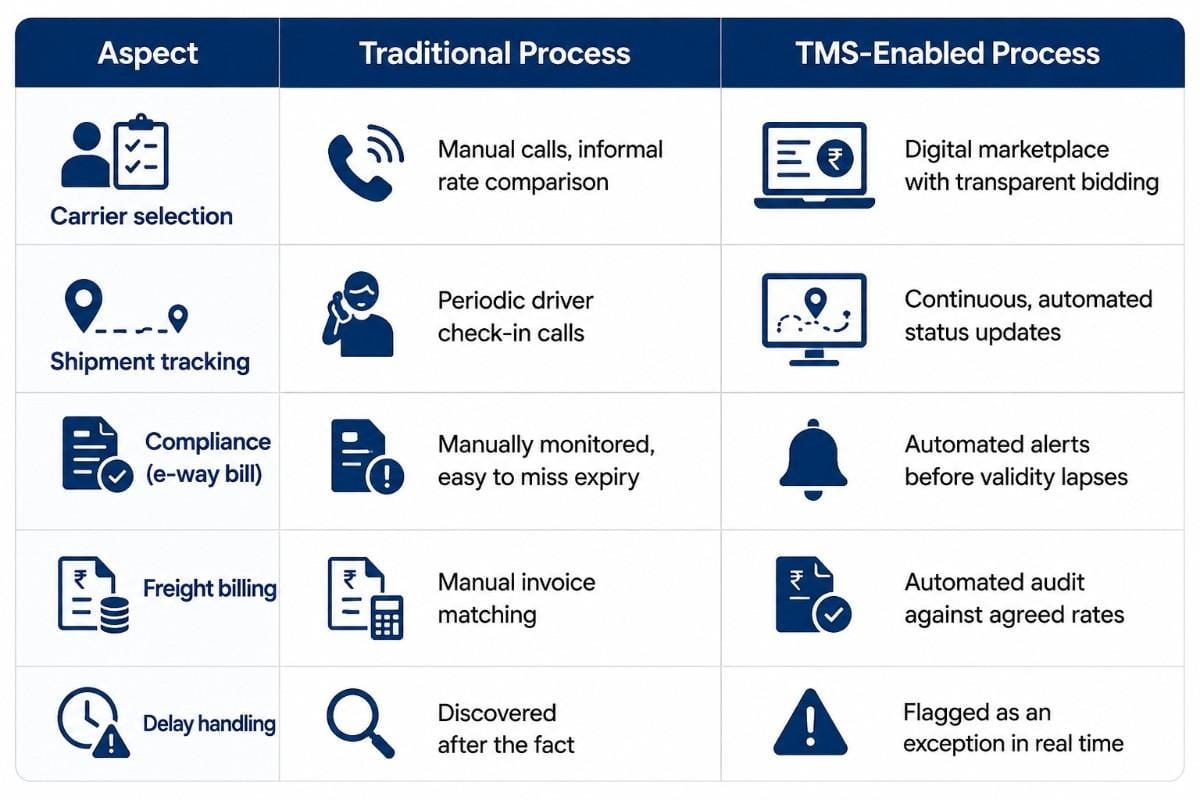
Traditional Freight Coordination vs. Digital TMS
How Should You Choose the Right TMS for Your Supply Chain?
Start with the deployment model and integration depth rather than feature lists. A cloud-based, SaaS-delivered TMS is now the standard path for most shippers because it avoids the multi-month, capital-heavy rollouts associated with on-premise systems. Check how the platform connects to your existing ERP, whether it needs new hardware on trucks you don't own, and how it handles the specific compliance layer relevant to your routes, e-way bills, and vehicle-fitness checks for domestic Indian freight, for instance.
Fleet size shouldn't be the deciding factor it once was. The global TMS market's projected growth to $68.4$ billion (₹6,528,780,000,000 approx.) by 2033 is being driven in large part by SaaS models that scale down to smaller, third-party-heavy fleets, exactly the profile of most Indian manufacturing supply chains, where transport is often outsourced to a mix of small operators rather than an owned fleet.
Conclusion
Indian manufacturing supply chains have historically absorbed the cost of fragmented, manual freight coordination, from missed e-way bill deadlines to unrecorded delays that surface only after a customer complains.
A transport management system addresses this by turning freight into a planned, trackable, and auditable function rather than a series of individual phone calls. Platforms like RoaDo are built for exactly this complexity, combining hardware-free tracking with automated compliance so that even fleets without in-house technical teams can operate this way.
As India's logistics cost benchmark continues to be measured and reported with more rigor, digitized freight management is shifting from a competitive advantage to a baseline expectation. The manufacturers who adopt it early will spend less time reacting to freight problems and more time running their actual business.
Frequently Asked Questions
1. What is a transport management system used for?
It's used to plan, execute, and track the movement of goods, covering route planning, carrier selection, freight billing, and delivery confirmation.
2. Is a TMS the same as an ERP system?
No, a TMS manages transportation execution specifically, while an ERP manages broader business functions like finance, inventory, and procurement, and the two typically integrate rather than replace each other.
3. What is the difference between a TMS and a WMS?
A TMS manages the movement of goods between locations, while a WMS (warehouse management system) manages storage, picking, and inventory within a warehouse.
4. Can a transport management system work without GPS hardware?
Yes, several modern platforms use SIM-based or browser-based tracking instead of dedicated GPS devices, removing the need for hardware installation.
5. Does a TMS help with e-way bill compliance?
Yes, many TMS platforms integrate with GSTN to auto-generate e-way bills and alert users before the validity expires.
6. How long does it typically take to implement a TMS?
Timelines vary widely by platform, ranging from a few minutes for lightweight, cloud-based tools to several months for complex, on-premise enterprise systems.
7. Is a TMS only useful for large enterprises?
No, cloud-based, modular TMS options are increasingly built for small and mid-sized fleets and manufacturers with fragmented, third-party-heavy transport networks.
8. What is the difference between a TMS and freight management software?
The terms are often used interchangeably, though "freight management software" sometimes refers more narrowly to rate management and invoicing rather than full route planning and execution.
“Ready to modernize your logistics operations? Discover how RoaDo's Transport Management System simplifies freight planning, enhances shipment visibility, and automates compliance. Book a free demo today.”