Gate Pass Format: Material, Returnable, and Vehicle Gate Pass Templates
Key Highlights
- A gate pass is an internal control document, so it never replaces a tax invoice, delivery challan, or e-way bill.
- Goods sent for job work must come back within one year for inputs and three years for capital goods.
- Inter-state job work movement needs an e-way bill, regardless of the consignment value.
- The field table below covers material, returnable, and vehicle gate passes in one place.
What Is a Gate Pass, and When Do You Need One?
A gate pass is a written authorization that lets goods or a vehicle cross the factory gate. You need one every time material leaves the premises, and many plants also issue one for every vehicle that enters. It's an internal control, which is why formats differ from plant to plant.
The law specifies the documents that must travel with the goods, and the gate pass should refer to the relevant document. A gate pass confirms that the movement has been approved by the plant. A delivery challan or tax invoice provides the required details for the movement of goods. In most cases, goods leaving the plant require both.
For goods that aren't being sold, such as items sent for repair, job work, or stock transfer, that legal document is a delivery challan under Rule 55 of the CGST Rules. It must carry a serial number of up to 16 characters, the consignor's and consignee's details, the HSN code, the quantity, the taxable value, and a signature. When goods move for supply, the challan is prepared in three copies marked for the consignee, the transporter, and the consignor.
Gate Pass Format: Fields for Material, Returnable, and Vehicle Passes
The three passes share a core set of fields, and each type adds a few of its own. Use this table to build any of them in Word or Excel.
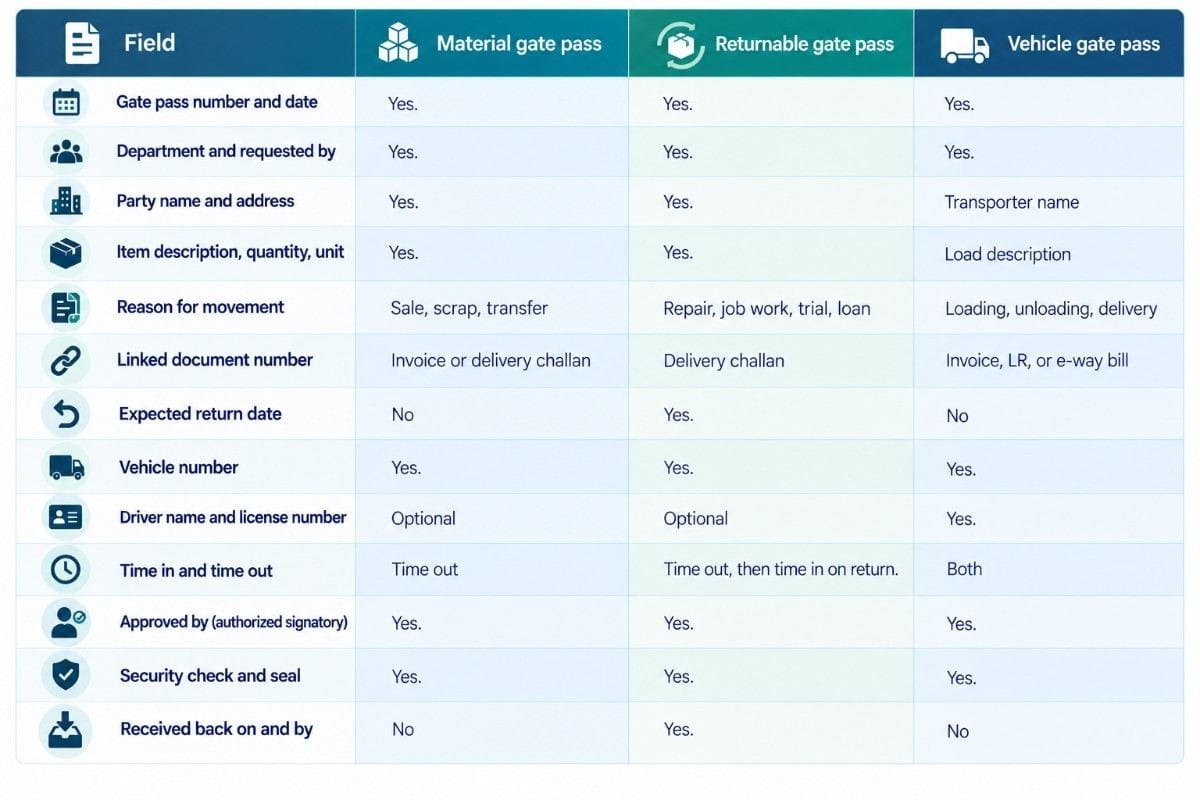
The linked document number ties the pass to a legal record, so an auditor can trace any movement. And the expected return date is the only thing that keeps a returnable gate pass from quietly becoming a lost asset.
Material Gate Pass Format: What Goes Out for Good
A material gate pass covers goods that won't return, whether that's a sale, a scrap disposal, or a transfer to another plant. Security checks the item and quantity against the pass, and the pass number goes into the outward register.
If the goods are being sold, the gate pass should quote the tax invoice number. If they're moving without a sale, such as a branch transfer, it should quote the delivery challan. A material gate pass format with an empty "linked document" field is the first thing an internal auditor will flag.
How Should a Returnable Gate Pass Be Tracked?

A returnable gate pass needs to be closed after the material is returned. An open pass means the material is still outside the plant, even though it belongs to you, and GST rules may set a time limit for keeping it out.
Inputs sent to a job worker must come back within one year, and capital goods within three years, though molds, dies, jigs, fixtures, and tools have no such limit. If those deadlines pass, the goods are treated as supplied to the job worker on the day they left, and tax becomes payable. The Commissioner can extend the periods by up to one year for inputs and two years for capital goods if sufficient cause is shown.
"Job work" means sending your goods to someone else for processing, such as machining, plating, or packing, while you still own them. When a principal in one state sends goods to a job worker in another, an e-way bill is required irrespective of the consignment value. In practice, keep a returnable gate pass register with the pass number, challan number, date out, expected return date, and actual return date. Review open passes every month, and chase anything nearing its deadline.
Vehicle Gate Pass Format: Controlling Trucks at the Gate
A vehicle gate pass records every truck that enters and leaves, who drove it, and why it came. At entry, security should note the vehicle number, driver name and license, transporter, purpose, and time in. At exit, they add the exit time, seal number, and the documents the truck carries. Comparing the two times also shows you how long trucks wait inside the plant, which is often where detention charges begin.
If the registration, insurance, or fitness certificate has lapsed, you find out only after the vehicle is already loaded or waiting. A freight operating system like RoaDo checks those details against VAHAN when a vehicle is assigned, so problems surface before the truck reaches your gate. It also gives your team live trip visibility without fitting any device to the truck.
Conclusion
A gate pass looks like a small piece of paper, yet it's often the only record of what left your plant and whether it came back. The fix is a gate pass format with clear fields, a linked invoice or challan, and, for returnable items, a return date someone actually tracks. Get that right, and audits, job work deadlines, and stock checks become far less painful. As trucks and transporters multiply, platforms like RoaDo are built for exactly that complexity. The plants that treat the gate as a control point, not just a checkpoint, will spot leaks long before they turn into losses.
Frequently Asked Questions
1. What is a gate pass format?
It's the slip your plant uses to let goods or a vehicle in or out. Most formats note what's moving, who signed off on it, and the time it crossed the gate.
2. What is the difference between a returnable and a non-returnable gate pass?
It comes down to whether the material is coming back. Send a motor out for repair, and you'd use a returnable pass, but scrap or sold goods go out on a non-returnable one.
3. Is a gate pass mandatory under GST?
No, GST doesn't ask for one at all. It's your own internal control. What the law does need is a tax invoice or delivery challan travelling with the goods.
4. What is a vehicle gate pass?
Think of it as the truck's entry and exit record. Security writes down the vehicle number, who's driving, why it came in, and when it arrived and left.
5. How long can goods stay with a job worker under GST?
Inputs can stay for up to one year, while capital goods can stay for up to three years. Molds, dies, jigs, and tools have no fixed time limit.
6. Is an e-way bill needed for goods sent on a returnable gate pass?
For interstate job work, an e-way bill is required regardless of the consignment value. For other movements, the standard ₹50,000 threshold applies.
7. Who signs a material gate pass?
The authorized person from the department sending the material signs the gate pass. Security then checks and countersigns it before the material leaves the premises.
8. Can a gate pass be maintained in Excel?
Yes, an Excel register can be used to track gate passes. Give each pass a unique number and record the related invoice or delivery challan.
“Tired of finding expired vehicle papers only after the truck reaches your gate? RoaDo checks every vehicle against VAHAN the moment it's assigned.”