
Transport Bill Format: Free Word, Excel, and PDF Templates
Key Highlights
- A GTA's transport bill must show gross weight, vehicle number, consignor, consignee, and the GSTIN of whoever pays the tax.
- From 22 September 2025, GTA services are taxed at 5% without ITC or 18% with ITC; the 12% option is gone.
- GTAs don't need to generate e-invoices, regardless of their turnover.
- A worked example below shows how freight, extra charges, and GST add up on one bill.
What Should a Transport Bill Format Include Under GST?
A transport bill needs two sets of details: the standard tax invoice fields from Rule 46 of the CGST Rules and the trip details from Rule 54(3) for goods transport agencies. Miss either set, and the bill isn't fully compliant.
A goods transport agency (GTA) is any person who transports goods by road and issues a consignment note, whatever it's called, as summarized by ICSI 2025. If you issue a lorry receipt or bill of lading, you're a GTA for GST purposes.
Here's every field your transport invoice format should carry.
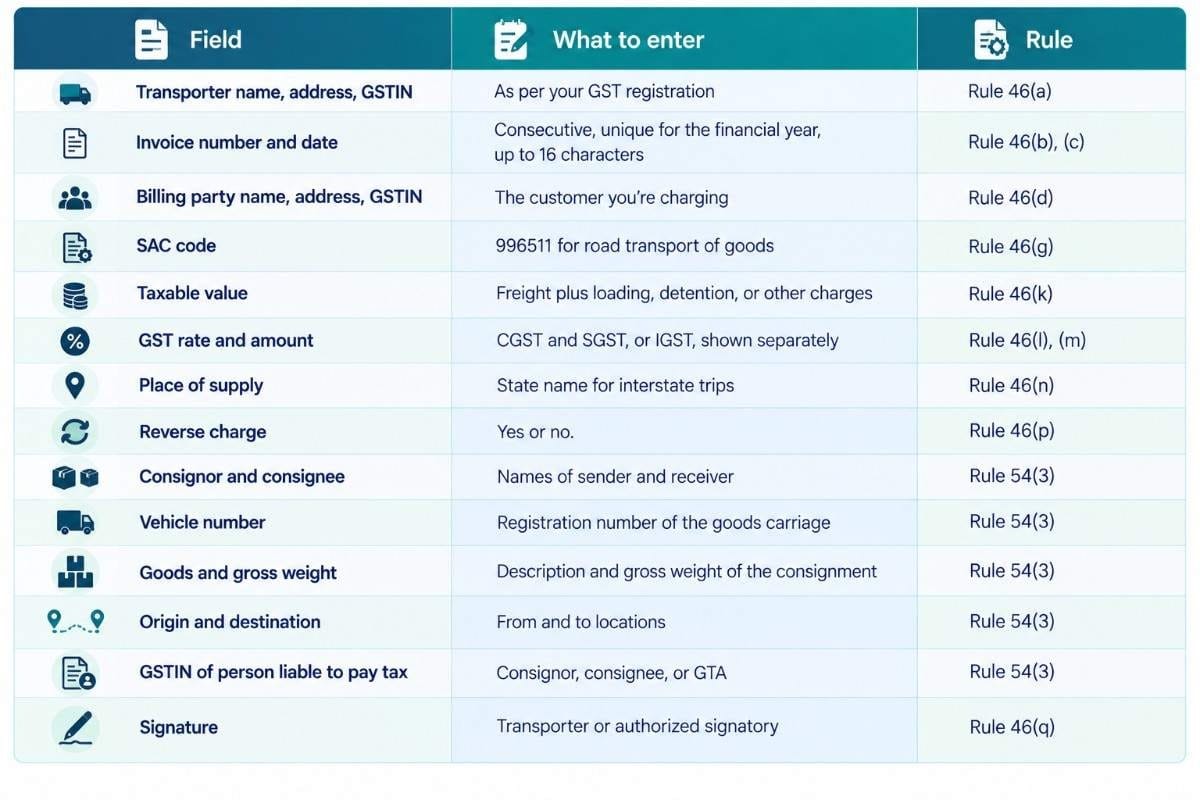
A plain GST invoice from accounting software usually has no space for vehicle number, gross weight, or consignee, which is why a transport-specific format matters.
How a Filled Transport Bill Format Reads
A filled transport bill should let anyone check the trip and the tax in under a minute. Here's a simple worked example using the fields from the table above.
Take a full-truckload trip from Bengaluru to Mysuru with freight of ₹45,000, loading of ₹1,500, and detention of ₹2,000, so the taxable value is ₹48,500. Both points are in Karnataka, and the transporter charges GST under forward charge, so the bill adds 9% CGST and 9% SGST of ₹4,365 each, for a total of ₹57,230.
If the customer were registered in another state, the same bill would show 18% IGST of ₹8,730 instead, because the place of supply follows the registered recipient's location. These figures are an illustration, not a rate benchmark. Keep the lorry receipt number on the bill. That one reference lets your customer match the invoice to the delivery without phoning anyone.
Which GST Rate Goes on a Freight Bill Format?

From 22 September 2025, GTA services attract either 5% without ITC or 18% with ITC, and the earlier 12% option has been replaced.
Under reverse charge (RCM), the customer pays the GST to the government instead of the transporter. The freight invoice still gets issued, but it shows tax payable on reverse charge: Yes, and charges no GST on its face.
At 5%, the tax is often paid by the business receiving the service under reverse charge, unless the transporter chooses to pay it. At 18%, the transporter charges GST on the invoice under forward charge and can claim credit on purchases such as tires, spares, and new trucks. Diesel sits outside GST, so it doesn't add to that credit.
Two more rules matter for your freight invoice. If both the supply and the payment happened before 22 September 2025, the old rate still applies. And GTAs are excluded from e-invoicing under Notification 13/2020-Central Tax, so a well-made template is still the legal document.
Transport Bill vs Transport Challan vs Transport Receipt
These three documents get mixed up all the time, but each does a different job. A transport bill, or freight bill, is the tax invoice that asks for payment. A transport challan format, often a delivery challan under Rule 55, travels with goods that aren't being sold, such as stock transfers or job work.
A transport receipt format, usually the lorry receipt or bill of lading, is the consignment note that proves the transporter has taken the goods. You'll typically need the receipt at loading and the bill at month-end or after delivery. Remember that an e-way bill is separate again. It's needed when the consignment value is more than ₹50,000, and quoting its number on your bill makes matching easier.
Common Mistakes That Delay Freight Invoice Payments
The bill shows the wrong GSTIN or a state code that doesn't match the place of supply. The rate charged doesn't match the agreed contract, or detention appears with no supporting record. The vehicle number on the bill differs from the one on the e-way bill. Or the reverse charge field is left blank, so the customer's accounts team can't tell who owes the tax.
For a transporter sending a handful of bills a month, a careful template handles all of this. For a manufacturer checking hundreds of freight invoices from dozens of transporters, it doesn't scale. That's the gap RoaDo, a freight operating system, is built to close. It audits each freight bill against the agreed rate, trip data, and ePOD before payment, which has helped users shorten their billing cycle.
Conclusion
A transport bill looks simple, but missing a vehicle number or a reverse charge flag is enough to stall a payment or block your customer's tax credit. The fix is a format that carries every field from Rules 46 and 54(3) and the post-September 2025 GST rates.
Build those fields into your Word, Excel, or PDF template, and you'll cover the compliance basics from the first trip. As invoice volumes grow, checking each freight bill by hand gets harder, and platforms like RoaDo are built for exactly that complexity. The transporters and shippers who get billing right early will spend far less time chasing payments later.
Frequently Asked Questions
1. What is a transport bill format?
Basically, it's the bill a transporter raises after a trip to collect the freight amount. Under GST, it also needs trip details, so the vehicle number, gross weight, and consignee all go on the same page.
2. Is GST applicable on transport bills?
Yes, it is. From 22 September 2025, you choose between 5% without ITC and 18% with ITC, and that choice decides whether you can claim credit on things like tyres and spares.
3. What is the SAC code for a transport bill?
The SAC code for road transport of goods is 996511. Use this code when preparing freight bills for road transportation services.
4. Who pays GST on a freight bill under reverse charge?
Under reverse charge, the customer is responsible for paying the GST. The freight bill is issued without adding GST, and the customer pays the tax directly to the government.
5. Is e-invoicing mandatory for transporters?
No. Transporters were kept out of e-invoicing back in 2020 under Notification 13/2020-Central Tax, so your turnover doesn't change anything here.
6. What is the difference between a transport bill and a lorry receipt?
A lorry receipt confirms that the transporter has received the goods for delivery. A transport bill is issued to charge for the transportation service.
7. Can I make a transport bill in Excel?
Yes, Excel is fine for it. Just check that the sheet has all the fields from Rules 46 and 54(3) before you start sending it out.
8. Is the 12% GST rate still available for GTAs?
No, that option's gone. Since 22 September 2025, your only choices are 5% without ITC or 18% with ITC.
“Checking hundreds of freight bills from dozens of transporters every month? RoaDo audits each one against the agreed rate and delivery proof before you pay.”