
SIM-Based Tracking: How It Works and When to Use It

Key Highlights
- SIM-based trackers transmit live location via mobile networks; SIM-less models only store data locally.
- Advanced SIM-based trackers enable real-time geofencing and route-deviation alerts for commercial fleets.
- AIS-140 compliance requires live dual-data transmission, a feature exclusive to SIM-based devices.
- RoaDo runs SIM-based visibility across 1.2 million+ tracked trips without installing a physical device on any vehicle.
What Does SIM-Based Tracking Mean for a Vehicle GPS Tracking Device?

SIM-based tracking is the method by which most commercial vehicle GPS tracking devices report location: a SIM card and cellular modem inside the device send position data to a server over the mobile network, the same way a phone sends a text message. The GPS component figures out where the vehicle is; the SIM component tells someone else.
This is worth separating clearly because the two functions are often bundled together in marketing but solve different problems. A device can calculate a highly accurate position and still be useless for live monitoring if it has no way to transmit that position anywhere. SIM-based tracking exists specifically to close that gap.
How Does a SIM-Based Vehicle GPS Tracking Device Send Data in Real Time?
In practice, a SIM-based GPS vehicle tracking device works like a stripped-down mobile phone that never makes calls; it just quietly reports its own coordinates on a schedule, typically every few seconds to a few minutes, depending on how the device is configured.
The device picks up satellite signals to calculate its position, packages that data, and pushes it through the cellular network to a cloud platform where it shows up on a live map. As long as the vehicle stays within mobile network coverage, this loop repeats continuously, which is what makes real-time dashboards, geofencing alerts, and route-deviation notifications possible in the first place.
When Is SIM-Based Tracking the Right Choice Over a GPS Tracker Without a SIM?
SIM-based tracking makes sense whenever a delay in knowing where a vehicle is costs something, a missed delivery window, an unauthorized stop that needs immediate follow-up, or a customer expecting a live ETA. Commercial FTL and PTL fleets, delivery vehicles, and any GPS tracking device for truck use built around scheduled deliveries fall squarely into this category.
The trade-off is a recurring data connection, either through the device's own SIM plan or a bundled subscription from the tracking provider. For a fleet manager, that ongoing cost is generally worth it, because the alternative, checking a stored log after a delay has already happened, doesn't actually prevent the problem.
When a GPS Tracker Without SIM Card Makes More Sense
A GPS tracker without a SIM relies on satellite signals to calculate and store location internally, without any network connection to send that data anywhere in real time. Retrieving the data means physically accessing the device or connecting it directly via USB or Bluetooth.
This approach fits situations where real-time visibility isn't the point. Someone tracking a personal vehicle for occasional trip logging, monitoring an asset that rarely leaves a fixed area, or operating in a region with no reliable cellular coverage may find a GPS tracker without a SIM card more practical, since it avoids a recurring subscription and keeps working regardless of network availability. What it can't do is alert anyone the moment something goes wrong.
Comparing SIM-Based and SIM-less GPS Tracking Devices for Different Use Cases
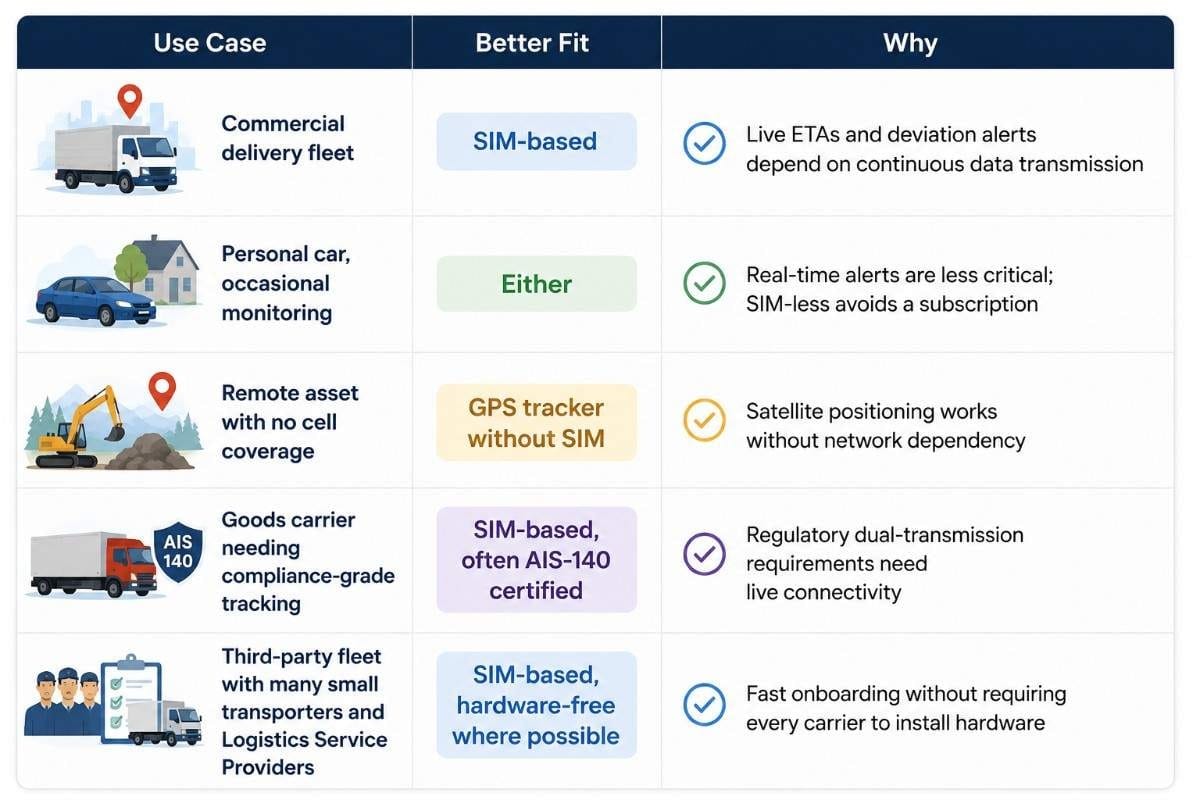
The right column in this table is less about which technology is better in the abstract and more about which one actually answers the question the reader is trying to solve.
Matching GPS Tracking Device Price and Type to Car, Truck or Fleet Use
The best GPS tracking device for car use is usually a SIM-based option with geofencing and basic alerts, since personal vehicles rarely need commercial-grade durability. A GPS device for a car typically offers these features in entry-level models.
Commercial and truck-fleet use looks different. A vehicle tracking device built for trucks needs a more durable housing and support for fuel sensors and driver ID inputs, and AIS-140-certified hardware adds further cost.
Devices in this category include a hard-wired panic button and dual transmission to transport and emergency authorities as required by the Ministry of Road Transport and Highways. For manufacturers coordinating a mixed fleet of owned trucks and hundreds of small third-party carriers, buying and installing a dedicated device on every vehicle isn't always practical.
RoaDo, operating as a Freight Operating System (FOS), addresses this by using hardware-free, SIM-based visibility combined with DPI integrations like VAHAN and GSTN to automate compliance without installing physical devices, thereby shortening onboarding for carriers who would otherwise resist installing new equipment.
Conclusion
Deciding between SIM-based and SIM-less tracking comes down to whether real-time visibility actually changes what you'd do with the information. Commercial fleets and delivery operations almost always need the immediacy that SIM-based tracking provides, while personal use and remote, low-coverage assets can often get by without it.
Platforms like RoaDo use hardware-free, SIM-based tracking to provide real-time shipment visibility without requiring a dedicated GPS device on every vehicle. Price and hardware requirements follow from that choice rather than driving it, so it's worth settling the use case first.
As more manufacturers manage fleets that mix owned vehicles with dozens of third-party carriers, hardware-free SIM-based approaches, such as those offered by platforms like RoaDo, are becoming a practical alternative to installing a tracking device on every truck.
Frequently Asked Questions
1. What does SIM-based tracking mean in a GPS device?
It means the device uses a SIM card and cellular network to transmit location data to a server in real time.
2. Is a gps tracker without sim card less accurate than a SIM-based one?
No, positioning accuracy is the same since both rely on the same satellite signals; the difference is in real-time transmission, not accuracy.
3. Does a vehicle gps tracking device always need a monthly subscription?
SIM-based devices typically require a data plan or bundled subscription, while SIM-less devices generally do not.
4. What is the typical gps tracking device price in India?
Basic SIM-based trackers are available in entry-level and advanced models, with features varying by configuration.
5. Can a gps tracker without sim still send alerts?
No, without a network connection, it cannot send real-time alerts; data must be retrieved manually from the device.
6. Is AIS-140 required for a gps tracking device for truck use?
AIS-140 is mandatory for passenger and public transport vehicles and is increasingly required by some enterprise shippers for goods carriers as well.
7. What's the best gps tracking device for car owners who just want basic monitoring?
An entry-level SIM-based tracker with geofencing and location alerts is generally sufficient for personal car use.
8. Do commercial fleets need a physical GPS vehicle tracking device on every truck?
Not necessarily; SIM-based, hardware-free platforms can provide comparable visibility without installing dedicated devices on third-party vehicles.
“Need hassle-free vehicle visibility? Explore RoaDo’s hardware-free tracking platform and get real-time shipment visibility without installing GPS devices.”