
Transport Management Software: What It Does, What It Costs, and How to Choose One in India
Key Highlights
- TMS pricing models (subscription, license, usage) distribute financial and operational risk differently.
- Usage-based pricing naturally flexes with volume but creates budget volatility during seasonal demand spikes.
- RoaDo’s zero-CAPEX platform delivers 5-10% freight savings and 65% faster billing cycles.
- AI alerts prevent over 1 lakh transit delays while reducing Days Sales Outstanding (DSO) by 7-10 days.
Every transport management software vendor prices things differently, and most of those differences aren't obvious from a sales page. Between subscription tiers, license fees, and usage-based charges that behave very differently once volume swings, comparing TMS options on price alone is close to impossible without first understanding what each pricing structure actually exposes a buyer to. This guide breaks down what the software does, how pricing models actually work, and what matters most when choosing one for an Indian fleet.
What Does Transport Management Software Actually Do?
Transport management software plans routes, manages carrier assignments, tracks shipments, and handles freight billing- the operational layer that sits between an order being placed and a truck actually delivering it. At its core, it replaces manual dispatch decisions and spreadsheet-based tracking with a system that can process the same decisions faster and more consistently.
That's the baseline function across nearly every TMS system on the market. Where products genuinely differ is in depth, how sophisticated the route optimization is, how many carrier integrations exist out of the box, and whether compliance and billing are built in or bolted on separately.
What a TMS System Covers vs What It Doesn't
A TMS system typically covers planning and execution, routing, dispatch, tracking, and freight audit, but it isn't the same as a full ERP, which handles inventory, finance, and order management more broadly. Confusing the two leads to buying either too much software or not enough. Core TMS functions cover FTL (Full Truckload) and PTL (Part Truckload) load planning, carrier selection, automated indenting, and electronic proof of delivery (ePOD) tracking.
What frequently gets left out and has to be evaluated separately is compliance handling specific to a market; in India, that means e-way bill generation, GSTN integration, and vehicle document verification through VAHAN. A generic global TMS built for a different regulatory environment often treats these as an afterthought if it handles them at all.
What Transport Management Software Costs: Pricing Models Explained
There's no single, reliable published figure for what transport management software costs in India; vendors quote pricing directly to prospects rather than publishing rate cards, and the global benchmarks that do circulate online come almost entirely from vendor marketing content rather than independent research. Rather than repeat unverified numbers, it's more useful to understand how each pricing model actually shifts cost and risk.
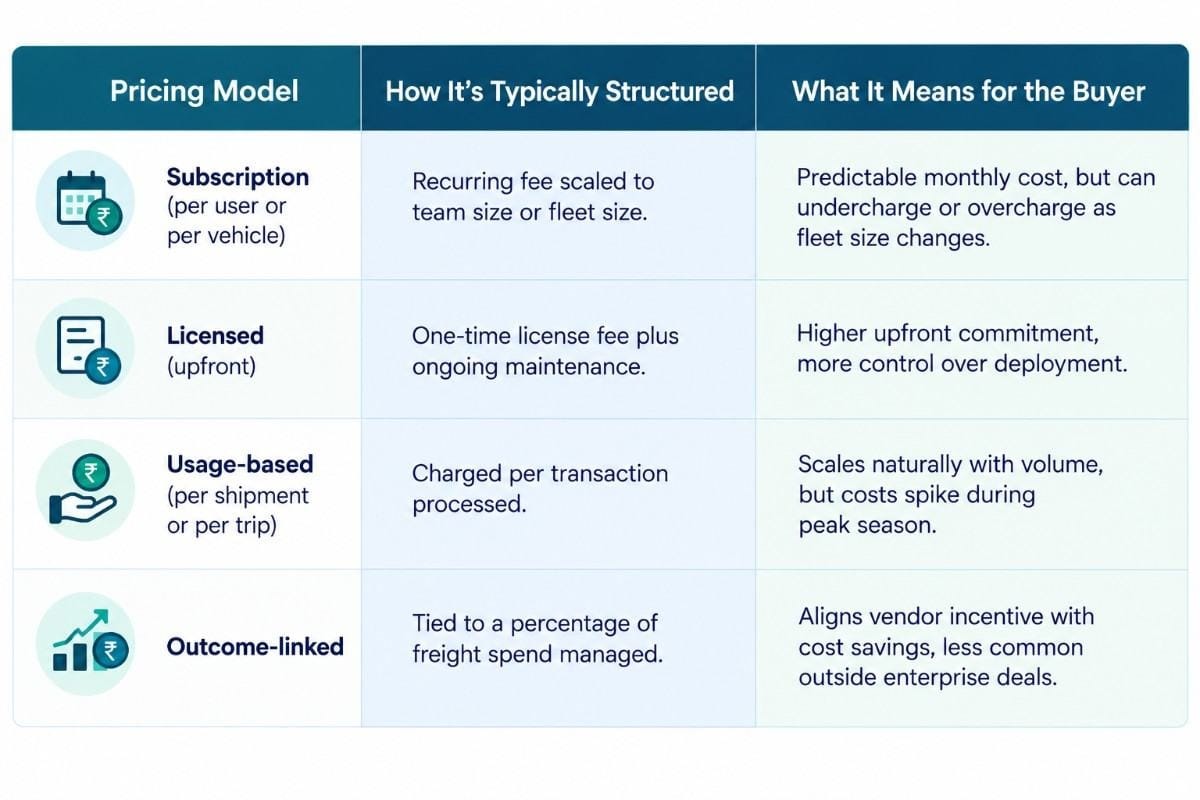
Whichever model a vendor proposes, the number worth asking about isn't the headline price; it's what happens to that number during a busy month and what implementation, integration, and training add on top before the system is actually working.
Fleet Management Software India: Where Local Pricing Differs from Global TMS
Pricing figures that circulate for transport management software mostly reflect large enterprise deployments elsewhere. Reliable, India-specific published pricing benchmarks are genuinely hard to find, since most Indian TMS and fleet management software vendors quote pricing directly rather than publishing it, worth saying plainly rather than guessing at a figure.
What's observable without a hard number attached: fleet management software India providers generally build pricing around usage or per-vehicle subscriptions rather than large upfront enterprise licenses, since that structure fits how most Indian fleets actually operate, coordinating a mix of owned and third-party vehicles rather than running one large, uniformly owned fleet. A manufacturer working with hundreds of small transporters needs a cost structure that scales with shipment volume, not a flat license sized for a fleet they don't own.
What Makes Logistics Software Truly India-Ready?
Logistics software in India must handle statutory compliance that global systems treat as optional. Automated e-way bill generation, real-time GSTN verification, and VAHAN integration for vehicle fitness and permit checks are essential for efficient and compliant logistics operations. This gap is exactly where India-specific platforms differentiate.
RoaDo, for instance, is built as a freight operating system with VAHAN and GSTN integration built into its core rather than added as a regional module, alongside SIM-based tracking that doesn't require installing hardware on third-party trucks a shipper doesn't own. For a business evaluating fleet management software options in India specifically, whether compliance is native or bolted-on is worth checking before comparing anything else.
How Do You Choose the Best TMS Software for Your Fleet and Carrier Mix?
The best TMS software for one business is often the wrong choice for another, because fit depends entirely on fleet size and carrier structure, not a universal feature ranking. A company running a small owned fleet with predictable routes has different needs than one coordinating hundreds of third-party carriers across variable freight volume.
Three factors can quickly narrow the vendor selection process: pricing that scales with actual shipment volume rather than fixed fees, native automation for VAHAN and GSTN compliance, and the ability to onboard external transporters in under five minutes without mandatory app downloads or hardware installations. Focusing on these factors helps avoid paying for capacity that a smaller or more fragmented operation may not actually need.
Conclusion
Transport management software pricing rarely stays as simple as a vendor's website makes it look, and reliable published numbers, especially for the Indian market specifically, are harder to find than the confident figures floating around online would suggest. The more useful question isn't which vendor quotes the lowest headline price, but which pricing model actually fits how a fleet operates and whether India-specific compliance is built in rather than bolted on.
Modern freight operating systems built around zero-CAPEX deployment and native GSTN and VAHAN integration, like RoaDo, sidestep legacy friction through modular SaaS adoption tailored to enterprise shipment volume, while customers consistently achieve 5-10% lower freight spend and 65% faster billing cycles.
Getting the choice right means starting with fleet structure and compliance needs, not a price comparison, and working backward from there. As more Indian logistics operations digitize, that fit-first approach is likely to matter more than any single number on a pricing page.
Frequently Asked Questions
1. What does transport management software actually do?
It plans routes, manages carrier assignments, tracks shipments in transit, and handles freight billing and audits.
2. How is transport management software typically priced?
Common models include per-user or per-vehicle subscriptions, upfront licensing with maintenance fees, and usage-based pricing tied to shipment volume.
3. What is the difference between a TMS and an ERP?
A TMS focuses on transportation planning and execution, while an ERP covers broader functions like inventory, finance, and order management.
4. Is usage-based pricing better than a subscription model?
It can work well at low, stable volume but becomes unpredictable during seasonal spikes since costs scale directly with shipment count.
5. Does fleet management software in India need different features than global TMS platforms?
Yes, India-specific compliance like e-way bill generation and GSTN integration is often not built into global TMS platforms by default.
6. What costs beyond the base price should be considered when budgeting for a TMS?
Implementation, system integration, training, and ongoing customization can all add meaningfully to the base subscription or license cost.
7. Can transport management software work with third-party carriers, not just an owned fleet?
Yes, though the ability to onboard external carriers quickly and cost-effectively varies significantly between platforms.
8. What's the first thing to evaluate when choosing the best TMS software?
Whether the pricing model matches actual shipment volume and whether compliance requirements are handled natively rather than as an add-on.
“Simplify transport operations with India-ready logistics software built for your carrier network. Discover how RoaDo can improve visibility, compliance, and freight efficiency.”