
What Is a Logistics Document Management System and Why Indian Companies Need One
Key Highlights
- A logistics document management system stores and organizes every freight record across its full lifecycle.
- GST law requires businesses to retain records for 72 months, which paper systems struggle to guarantee.
- Failure to maintain required records can attract a penalty of ₹10,000 or the tax evaded, whichever is higher.
- Documentation and compliance remain a high-cost component of India's logistics spend.
What Is a Logistics Document Management System?
A logistics document management system is software that captures, stores, organizes, and retrieves every record tied to the movement of goods, from the moment an order is raised to final billing. Instead of bills of lading sitting in one folder, proof of delivery slips in a driver's bag, and invoices buried in email, everything lives in one searchable place. The goal is simple: the right document is available at the right time, without anyone digging through paper or chasing a branch office for a scan.
It helps to be precise about what this means, because three terms get blurred. Scanning turns paper into an image. Digitization captures and structures the data inside so it can be searched. Document management is what keeps all those digital logistics records organized, linked to the right shipment, and accessible across teams. A real system does all three, not just the first.
Which Documents Does It Actually Manage?
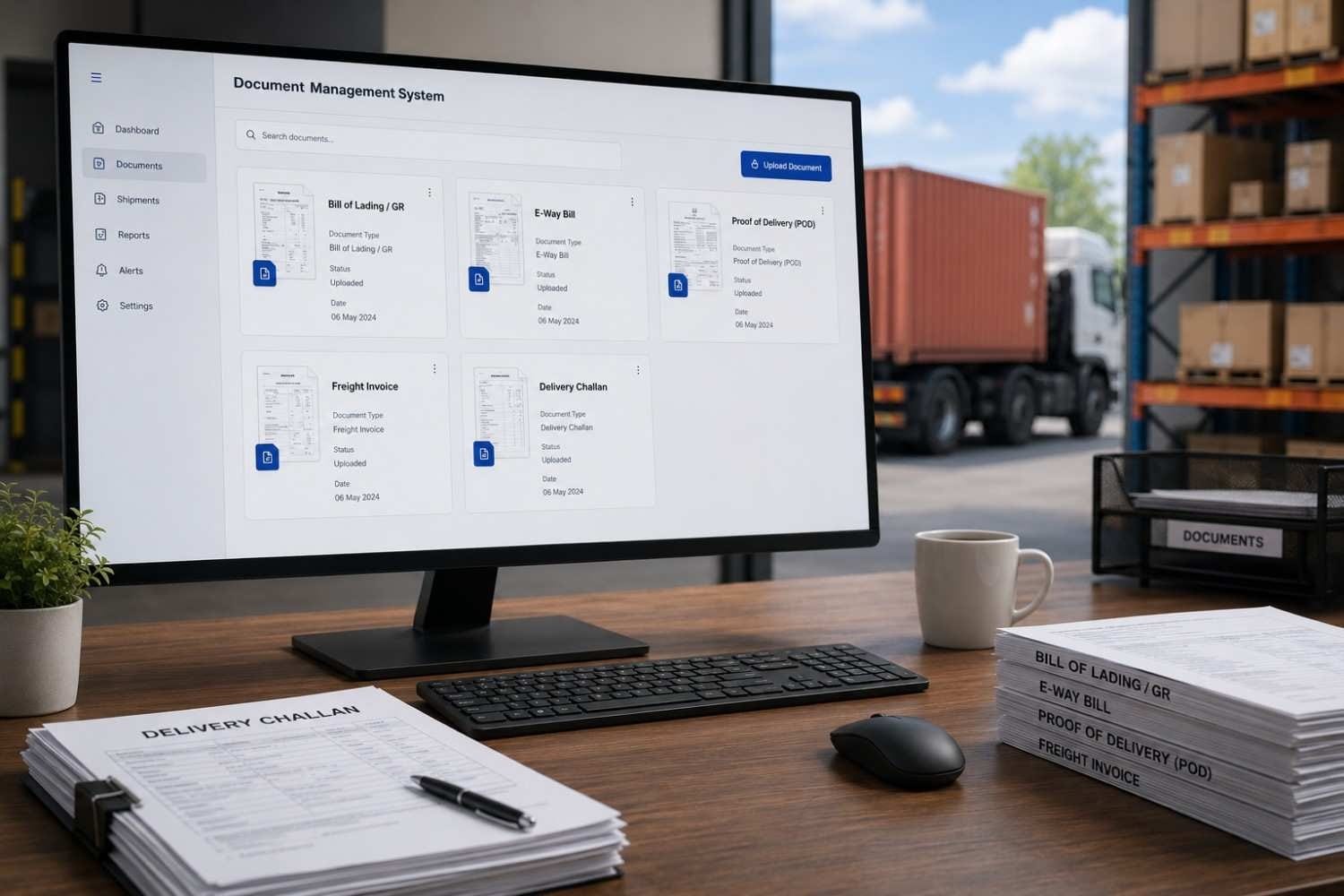
It manages the full paper trail of a shipment. Freight document management covers bills of lading, proof of delivery, freight invoices, e-way bills, delivery challans, and goods receipts, plus any customs or compliance paperwork for cross-border moves. These records pass through drivers, warehouses, dispatch, and accounting before they are used for billing or an audit, which is exactly why they get lost in a manual setup.
From Order to Delivery to Billing
Each document maps to a stage, and the system's value is keeping them connected. An order generates a challan or invoice, dispatch produces the bill of lading and e-way bill, delivery produces the POD, and billing pulls them all together. When a POD is delayed or lost on paper, the invoice waits, and cash flow slips. Electronic proof of delivery with a timestamp and signature closes that gap and lets billing proceed immediately.
Why Do Indian Companies Specifically Need One?
Because Indian compliance makes records mandatory, not optional, and paper makes them fragile. Under GST law, every registered business must retain its books of account and records for 72 months from the due date of the relevant annual return. Failing to maintain or retain required records can attract a penalty of ₹10,000 or the amount of tax evaded, whichever is higher. A box of fading PODs in a warehouse is a liability waiting for an audit.
Retention here means you must be able to produce a complete, accurate record years after the shipment, not just file it and forget where it went.
The cost angle reinforces this. India's logistics cost is officially estimated at 7.97% of GDP, and the government's own assessment notes that documentation and compliance remain a high-cost element of that total. Time spent reconciling paperwork, re-keying data, and recovering from lost documents is pure waste. A freight operating system like RoaDo addresses this by integrating directly with GSTN, so e-way bills and related records are generated and stored digitally as part of the workflow rather than handled separately after the fact, which turns compliance from a manual scramble into a by-product of normal operations.
What to Look for in Logistics Paperwork Software
Look for four things: fast retrieval, controlled access, integration, and digital proof of delivery. Strong logistics paperwork software lets you find any document across thousands of files through search rather than folder browsing, often using OCR to read scanned records. Role-based access means auditors, accounts teams, and transport partners see only what they need, while sensitive financial data stays protected.
Integration is what separates a filing cabinet from an operating system. Records should flow automatically from your ERP or transport workflow into the document layer, so nothing is re-entered by hand. The same applies to billing: when ePOD and invoice handling are automated, the billing cycle accelerates and disputes drop because the supporting record is attached to the transaction from the start. A platform that combines transport records management with automated invoice audit and reconciliation, the way RoaDo's freight finance module does, ties the document trail directly to the money it supports. The result is fewer gaps, faster closes, and a clean record when an auditor comes calling.
Conclusion
For most Indian logistics operations, the real problem is not a shortage of documents but the chaos of managing them on paper while the law demands years of clean, retrievable records. A logistics document management system solves both halves of that problem at once, cutting the time lost to misplaced paperwork and making GST audit readiness a routine state rather than a fire drill. The key insight is that records are not just admin; they are the proof behind every payment and every compliance check, and they deserve a system built to protect them. As Indian freight grows more digital and more tightly regulated, the companies that treat their document trail as structured data will move faster and worry less.
Platforms like RoaDo are built to make that kind of clean, compliant record-keeping a natural part of how goods move.
Frequently Asked Questions
- What is a logistics document management system?
It is software that captures, stores, organizes, and retrieves all freight-related records across a shipment's lifecycle. - What documents are used in freight and logistics?
The core ones are the bill of lading, e-way bill, proof of delivery, freight invoice, and delivery challan. - How long must GST records be kept in India?
Registered businesses must retain records for 72 months from the due date of the relevant annual return. - What is the difference between scanning and document management?
Scanning converts paper to digital files, while document management keeps those files organized, linked, and retrievable. - What is an ePOD?
An ePOD is an electronic proof of delivery with a digital signature and timestamp that confirms goods were received. - Can logistics documents be stored digitally for GST?
Yes, the GST law permits records to be maintained in electronic form, provided they are backed up and accessible. - What is the penalty for not maintaining records under GST?
It is ₹10,000 or the amount of tax evaded, whichever is higher. - Does a document management system integrate with ERP or TMS? Yes, a capable system integrates with ERP, TMS, and other software to avoid manual data re-entry.
Simplify freight documentation, automate GST-compliant workflows, and manage every logistics record seamlessly with RoaDo.